
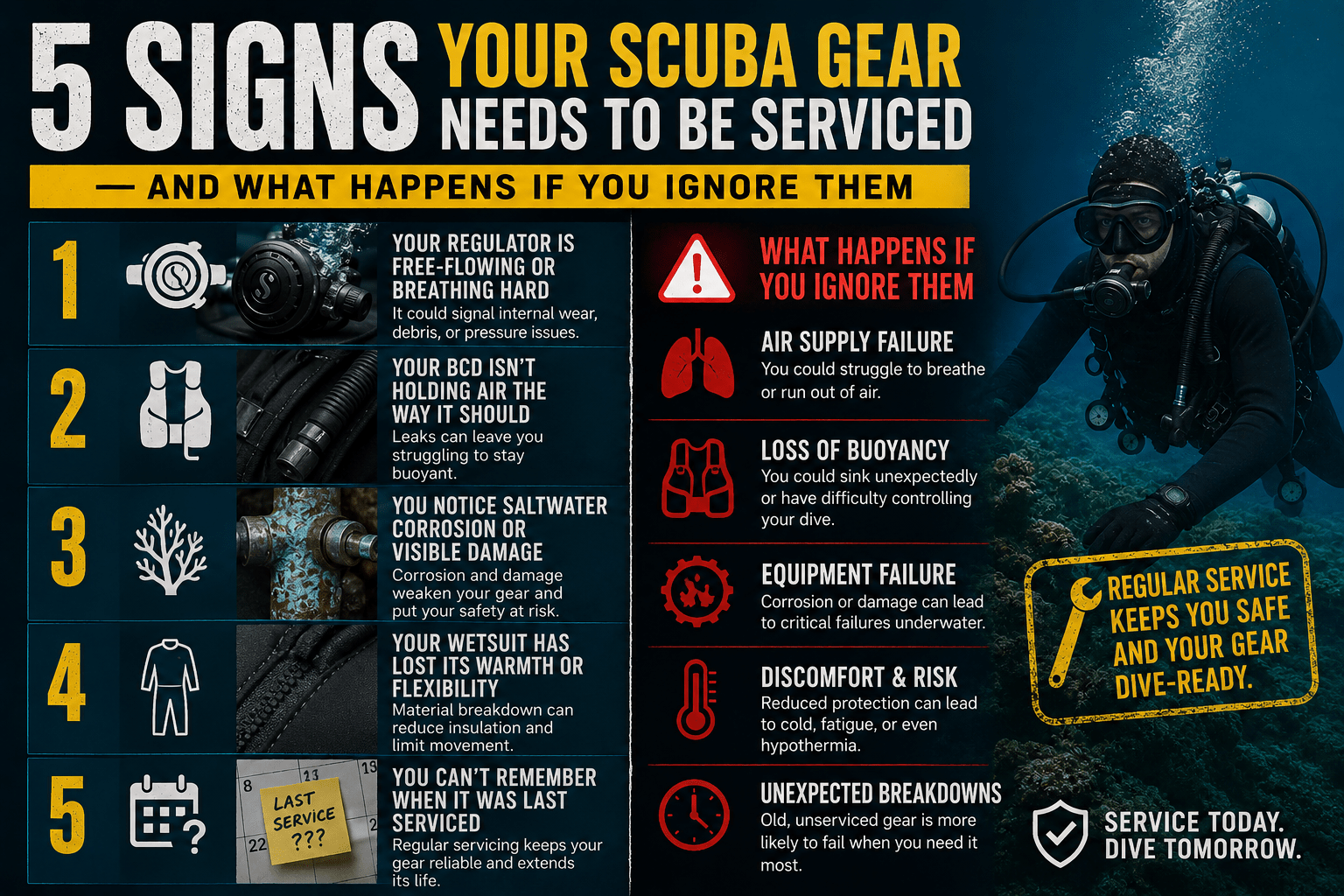
5 Signs Your Scuba Gear Needs Professional Service
Gear Reviews · 6 min read
Your scuba gear is the only thing standing between you and the underwater world. Regulators, BCDs, dive computers, and wetsuits are precision instruments that take a beating every time you dive — from saltwater corrosion and pressure cycling to UV exposure and general wear. Like any critical equipment, they need regular attention to perform reliably.
The problem is that gear degradation is gradual and often invisible. Unlike a car that flashes a warning light or a phone that tells you the battery is dying, scuba equipment tends to fail quietly — until it doesn’t. Knowing what to look and listen for can mean the difference between a great dive and a dangerous situation.
Here are five signs your scuba gear is telling you it needs professional attention.
1. Your Regulator Is Free-Flowing or Breathing Hard
A well-serviced regulator should breathe effortlessly at any depth. If you notice your regulator free-flowing unexpectedly — releasing a continuous stream of bubbles without you inhaling — or if it feels unusually hard to breathe from, something is off internally.
Free-flowing is often caused by a worn or contaminated seat in the second stage. Hard breathing can indicate a first or second stage that’s out of adjustment or has internal buildup from salt and mineral deposits. Neither issue resolves itself, and both can escalate underwater. If your regulator is behaving differently than usual, get it looked at before your next dive.
2. Your BCD Isn’t Holding Air the Way It Should
Inflate your BCD fully and let it sit. Does it hold air, or does it slowly deflate over the next few minutes? A BCD that won’t hold pressure has a bladder leak — and a leaking bladder underwater means you can’t maintain neutral buoyancy reliably, which is a genuine safety concern.
Also check the inflator mechanism. If it sticks when you press the inflate button or doesn’t release cleanly, the inflator assembly needs servicing. These are simple fixes when caught early and expensive problems when ignored until they fail on a dive.
3. You Notice Saltwater Corrosion or Visible Damage
Inspect your gear after every dive season — and ideally after every trip to saltwater. Look for white or green deposits around metal fittings, corroded DIN or yoke connections, cracked or brittle hoses, and any discoloration on rubber seals or mouthpieces.
Salt is extraordinarily corrosive over time. It works its way into threaded connections, valve seats, and O-ring grooves, compromising the integrity of the seal. Corrosion you can see on the outside usually means more corrosion is occurring on the inside. A thorough freshwater rinse after every saltwater dive significantly slows this process — but it doesn’t eliminate it. Annual service by a certified technician is the only way to address internal corrosion before it becomes a problem.
4. Your Wetsuit Has Lost Its Warmth or Flexibility
Neoprene doesn’t last forever. A wetsuit that once kept you comfortable at 55°F but now leaves you shivering by the end of a dive hasn’t changed — the neoprene has compressed over time and lost its insulating properties.
Look also for delamination (the inner or outer lining separating from the neoprene), tears along the seams, and zipper problems. Small tears can be repaired with neoprene cement. Zipper issues are often fixable with proper lubrication and cleaning. A wetsuit that’s structurally compromised, however, is best replaced — your thermal protection depends on it, especially in New England waters where temperatures demand a suit that performs.
5. You Can’t Remember When It Was Last Serviced
This is the most common sign of all — and the most important. If you have to genuinely think about when your regulator was last professionally serviced, it’s time. The industry standard is annual service for any regulator used regularly, regardless of how it feels. O-rings, springs, and seats degrade on a timeline, not just with use.
Gear that sits unused between seasons is not exempt. In fact, rubber components that dry out in storage can degrade faster than gear used regularly in the water. If your rig has been in the garage since last October, it needs to be looked at before you trust it at depth.
Bring It In — Before the Season Gets Away From You
At Scuba Shack CT in Newington, Connecticut, our certified technicians service most major brands including Apeks, Aqualung, Atomic, Hollis, Zeagle, Sherwood, and more. We use OEM parts and work with the same standards the manufacturers specify.
The best time to service your gear is before you need it — not after something goes wrong on a dive. Stop in, give us a call, or drop your gear off during store hours. We’ll have it ready before your next dive date.
What We Service
Certified technicians · OEM parts · Most major brands
Regulators
First and second stage overhaul, IP adjustment, demand valve tuning. Most brands serviced with OEM kits.
BCDs
Bladder leak testing and repair, inflator mechanism service, dump valve replacement, oral inflate tube inspection.
Wetsuits & Drysuits
Seam repair, neoprene patching, zipper cleaning and lubrication. Drysuit seal replacement available.
Don’t Wait for a Gear Failure Underwater
Drop your gear off at Scuba Shack CT in Newington — we’ll have it dive-ready before your next trip.
Leave a Reply